Transcript
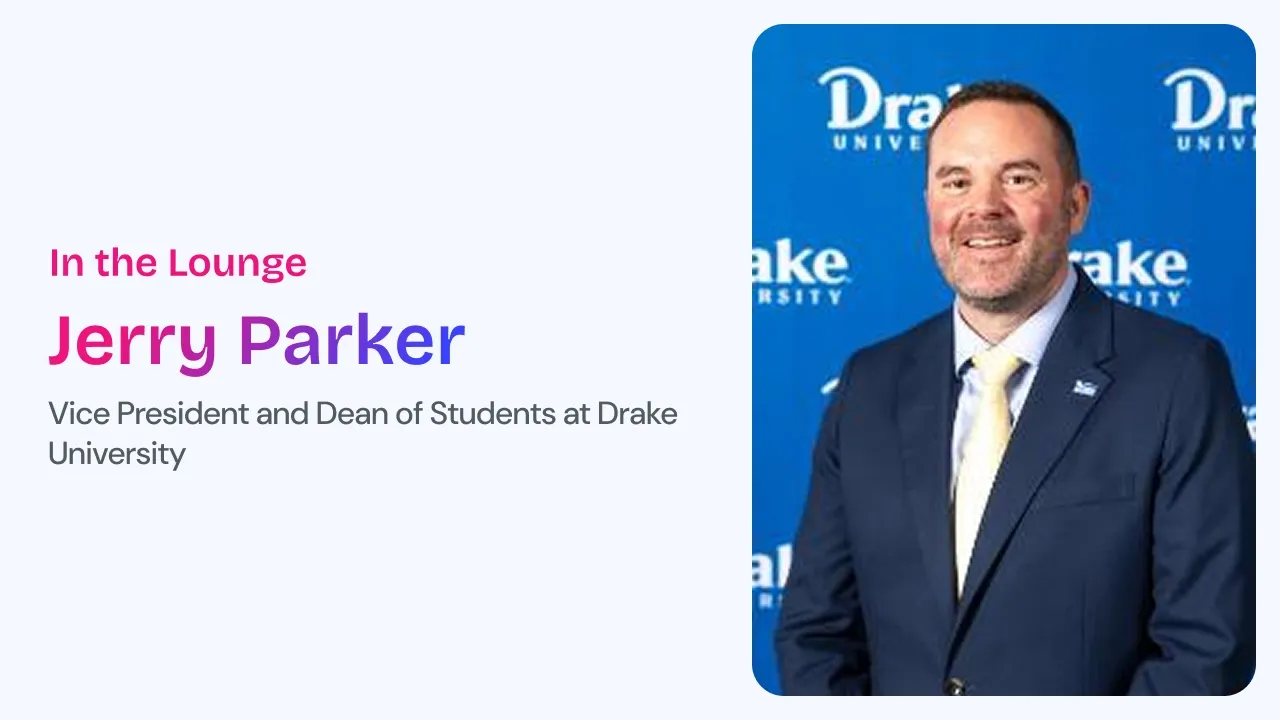
In the Lounge with Dr. Jerry Parker
Dominic (00:00 — Introduction):
Everyone and welcome to this episode of In the Lounge. On this podcast we meet with experts from the higher education field to share ideas, learn from their experiences, talk about new trends we're seeing, and get an unseen perspective of what's going on in the space. If you have questions for my guests today, just send them over via email and get you in touch. My email is dominic@lounge.live.
Today we're in the lounge with Dr. Jerry Parker, Vice President and Dean of Students at Drake University. Dr. Parker is a veteran student affairs executive with decades of experience advancing student success, leadership development and inclusive campus communities. Since joining Drake in 2014 and serving as Dean of Students, he has led the student affairs division with a clear focus on integrating the co-curricular experience with academic and personal development.
Prior to Drake, Dr. Parker held student affairs and teaching roles at institutions including Texas State University, St. Mary's University, Iowa Wesleyan College, Texas A&M University, and Des Moines.
He's also been recognized for innovation and achievement in student life and remains deeply committed to civic engagement and preparing students for leadership beyond campus.
Jerry, welcome. Thanks for joining me.
Jerry Parker (01:00):
Glad to be here with you, Dominic.
Dominic (01:02 — Jerry's Journey into Student Affairs):
So I covered just a little bit of the highlights from your working career, but could you give us the Jerry Parker version? Could you give us an introduction maybe about your story, your background, and how you got into the space?
Jerry Parker (01:11):
Sure, absolutely. I'll try to make this as quick as possible. I grew up in New England. My mother's side of the family is down in Texas, so I decided to go to school down in Texas. I went to Texas State, earned my undergrad and master's degree down there, and then went to Texas A&M for my PhD. While at Texas State, I decided to run for student body president, and I won that election and became student body president. And from there, I had our dean of students at the time, John Garrison say, you know, have you ever considered a profession? Have you ever considered the profession of student affairs? And, you know, and I said, well, what is student affairs? No one goes to college to go be a student affairs practitioner. We just, we just don't. And so he says, that's what I do. And during my tenure as SBP at Texas State, I got to be involved in a lot of different committees and really enjoyed working in higher ed. And so did a job in public policy for about a year and a half outside of college. And my focus just kept returning to higher ed and higher ed policy. And the gentleman that I was working for, he had previously been on the Texas Higher Education Coordinating Board and knew that I had a niche for higher ed. And so he brought me along to different events that he would go to, speak at, and then had me do a number of research projects for him. And at that time, that's when I was enrolling at Texas A for my doctoral work. And from there, I took a job with my alma mater at Texas State as a student affairs coordinator, working in volunteer services. And it was just a great opportunity. It was a great experience. I really enjoyed it and I was probably 23, 24 at the time and so looking back now 20 years it's been an interesting ride I'll put it that way.
Dominic (02:50 — The Role of Mentorship):
Yeah, I think that's interesting, you mentioned two kind of common threads I see. One is there are a lot of folks who are in this space who didn't know about it or didn't realize how amazing it was. And before someone brought it to them, they didn't have it in their plan. And then all of a sudden they see the opportunity and they see the exciting work that can be done and they jump at it. So I've seen that. And then I also see very commonly there's often a mentor or someone who says, hey, have you thought about this? Hey, you should do this. I think having that mentor, I think mentorship is quite common in this space. And I think it's such an important part of the industry that we're in. So yeah, that's a common thing. And in your perspective, there things? Absolutely, yeah, definitely. And do you think that there are certain elements where while you were skilled, obviously, obviously you were skilled at a lot of these leadership positions and the position that you were in felt kind of like a good fit, but were there points where you're like, this is a genuine passion of mine? Like, did it speak to you on interest and passion level as well?
Jerry Parker (03:25):
Absolutely.
Jerry Parker (03:47):
Yeah, absolutely. Absolutely. Getting to work with students. You know, that was what drove me is I got to continue working with students that had an interest in either leadership development or, you know, social engagement, civic engagement, look at being social entrepreneurs in regards to benefiting the greater community. They wanted to take the lessons that they were learning from class like the theory and put it into practice. And so, you know, they had that opportunity through the co-curricular environment. And I just got really excited about that opportunity to be able to work with our students at that level.
Dominic (04:25 — What Motivates the Work):
Amazing. So what is it that motivates you every day to do the work that you do?
Jerry Parker (04:29):
I would say it has to go back directly to the students. I mean, if you don't have a passion working with, you know, your students at your respective college or university, you're going to lose that pep in your step. And for me, yes, it can be draining, depending on what the circumstances that you're working with a student on. But you hope that at end of the day, when you put together this roadmap for a student, knowing that you're not necessarily going to be able to do it for them. And you see them trudging along to this road to happy destiny, so to speak. And they start understanding all the different intricacies that go into how to become a collaborative leader, how to become a critical thinker, how to become a communicator across difference, all those aspects. And you see the light bulbs turn on, you know, for me, that is very motivating in my work because I feel as though we as colleagues are doing something to add to the environment, to that student experience, the out of classroom experience.
Dominic (05:19 — Advice for New Professionals):
Yeah, and I think, yeah, in a leadership position, you're really building the ability to share a skill set and develop a skill set and teach that to someone so that they can then go do that themselves. And you're creating better, more skilled people. And I think the impact can be quite huge when you can do that, especially at an institution where you're maybe impacting thousands of students. It can be incredibly rewarding.
When you think about new folks getting into the space, maybe someone thinking about a career in student affairs, higher education more generally, do you have any advice for them right now? Obviously, the space is different than 10 years ago, and it will be different in 10 years. What sort of advice do you have as they kind of consider that and get started?
Jerry Parker (06:03):
Yeah. Yeah, I mean, the field has definitely changed in the last 20 years since I started out in it. And that's not a bad thing. I mean, everything evolves, everything changes over time. And I think that's the mindset you have to go into the profession with. That when you come in, it's not going to be that way when you exit stage left. It's just not. Things constantly evolve, things constantly change, students change, society changes, all those things. You know, we are at a college or university, we are considered a town, a city, you know, whatever you want to, whatever you want to call it. And so I think it's important for new practitioners or folks that are considering the field to know that, you know, it's okay not to have all the answers. It's okay not to know exactly the next step you're going to take within the field, but to enjoy the moment, to enjoy the experience, get the most out of it, try to look into what areas you really want to develop your skill set in when it comes to student affairs. Because there's so many different opportunities out there. I mean, it could be on the counseling side of things, it could be on the res life side of things, it could be on leadership development, rec services, you name it. The list goes on and on. And so, you know, there's something for just about anybody here. You have to have that desire though to want to work and be alongside students during that journey.
Dominic (07:24 — Current Trends in Student Engagement):
But that's a really interesting point, and giving yourself the time to identify that specific sort of niche that you want to work in because it is such a broad space with so many different directions that you can go with it. And you can be really specific in what you do. So connecting with that specific interest is kind of a superpower almost. And it can give you that wind that you'd like to really go all the way with it.
So we talked about the space changing over 10 years, 20 years, what are some of the trends you're seeing right now in student engagement? Maybe on your campus, but more broadly across other campuses, what you're hearing at different conferences that you may go to.
Jerry Parker (08:01):
Sure. You know, I think knowing that we're so close to coming out of COVID, you know, it's so recent in our memories. COVID was here. We clearly saw a change in student engagement or the ways that students were engaging with one another. There was more of the concern for us in regards to face-to-face communication and the fear of more social isolation amongst our students. And now that we're a few years out from COVID, I can tell you that our students have really rebounded and they've come out of that period of time well ready to hit the ground running to make up for lost time. And so, at first we were a bit concerned about the social isolation that they were navigating, but in the long term, right now, what we're seeing is that period kind of the isolation isn't really there anymore. There's a lot of excitement to get back into the fold, get back into the mix of things that are more traditional for students when they look at their student experience, being involved in clubs and organizations, intramurals, competing against other colleges and universities, seeing athletics back at its full peak. So that was definitely one of those things that was of a concern. I would say that our students nowadays by and large want to know the rationale that goes into why we're doing something. You know, what makes, does this make sense? Well, if it makes sense, explain the rationale as to why it makes sense. And I speak to that more along the lines of the work that we're doing in student affairs when I work with my team and our colleagues is that if something gets presented to us to consider an initiative, a program, a project, whatever it may be. The students, they want to be involved and engaged with it and they want to know that it's going to serve a greater purpose than themselves. So there's that altruistic mindset and altruistic, so to speak, way of going about it. And I think that's commendable for the students in this generation, that they're looking out for the greater good and they're thinking about not only how does something impact their own campus community, but the community at large, beyond the four walls of an institution.
Dominic (09:55 — Engagement Data Trends):
Mm-hmm. Mm-hmm. And I've heard similar things and we've seen similar things across the space. And I found an article that came out earlier this year and I wanted to share it with you and sort of get your thoughts but it resonates exactly with what you're saying and I don't want this to be an insult to any of us who aren't Generation Z but Gallup did a study that was published earlier around August I think and it said that Gen Z students are more engaged across the board in school than in any previous years. Are you seeing this in real time with students and what are your thoughts around that?
Jerry Parker (10:37):
Absolutely, I'm seeing it. I'm seeing it through our NSSE scores. You know, Drake has very high NSSE scores when it comes to student involvement and engagement. You know, when you ask students at their senior year when they're doing NSSE, you know, what they've been involved in, have they taken on a leadership position? I can only speak for Drake University, but our students are highly engaged. That percentage is very high when we compare it to our peer institutions and benchmark institutions. We're above those schools. And so what I'm seeing on the ground here at Drake relates directly to what the Gallup study is disseminating, it's sharing.
Dominic (11:12):
Yeah, no, and it's exciting. I think it does show a good trend. You know, as we follow this space over the next few years, I think that if that trend continues, well, higher ed is going to be in really exciting place. And I think with all of the innovation that's going on and all of the communication that we have across campuses, it's an exciting time. And yeah, I just I'm pretty excited to see where that where that takes us.
Jerry Parker (11:34):
I mean, it truly is an exciting time. You know, one of the things that I always try to get across to students is students are our colleagues. Okay. I don't know everything. They don't know everything. And sometimes we're just going to learn it together and we're going to do things together and figure something out. And the more students are engaged and willing to be vulnerable to do those types of things, the more we as practitioners are vulnerable to admit, hey, we don't know everything. We don't know if this is necessarily the best thing for our students. There are eyes and ears out in the campus community. You know, we can do this together. And I think there's a lot of excitement out there for what's to come.
Dominic (12:07 — A Day in the Life of a VPSA):
I want to shift gears a little bit. What does your day look like day to day as Vice President of Student Affairs? Can you tell us a little bit about that for those who aren't in that role? What does it look like? How do you spend your time?
Jerry Parker (12:17):
Yeah, sure. So I'm an early riser. I wake up very early in the morning, hit the gym, try to do a few coffee meetings before coming into the office, get in here. And throughout my day, I'm meeting with students, I'm meeting with colleagues, different departments, trying to, you know, once again, move whatever the agenda item is or the agenda items throughout the day. I mean, no day is the same. I mean, you're going from either a really cool issue to a really tough issue to a personally tough issue, meaning that it's personal for the student that you're working with to help them out. To maybe a luncheon. And then from there, you know, throughout the afternoon, you know, more meetings. I try to carve off some time to get caught up on emails. So I think there is a lot of value and benefit not to over schedule your day. I mean, look, if the reality is something's going to come onto your calendar, whether you expected it or not, it's just going to happen. And then from there, you know, during the semester, I'm at a lot of evening events. So a lot of student organizations put on different events and those, you know, happen, you know, any given night that I'm back here on campus and then the weekends, going to different events on campus. So during the fall and spring, you expect you're going to be put in a lot of hours. And it's not, it's not to say that it's not the kind of count straws here, so to speak. I do this work because I feel value and it fills up my well, my professional well, in the sense that I enjoy being out there to support our students. I'm not out there just to stand to say I've been seen. I'm out there to recognize and see the work that our students are putting forward. And so every day is different. That's why breaks mean so much to us. We're getting ready to start our winter break, two weeks. This is a time, and I've shared this with all my colleagues, this is your time to rest, rejuvenate, whatever it is, get some respite, and we'll come back ready to go for the spring semester.
Dominic (14:08 — Making an Impact):
Amazing. So what is the biggest impact you can have for students as a VPSA and dean of students?
Jerry Parker (14:13):
Presence. The biggest impact you can have in this role is your presence. If I'm doing my job and I'm doing a good job, I shouldn't be in my office very much. And seldom am I in my office. I'm not in my office right now doing this podcast with you. I think it's really important for anybody in this role, whether you're a vice president for student affairs, whether you're a dean of students, whatever your role is in student affairs, it's to be out and about and to be building new relationships and strengthening the existing relationships that you have with your colleagues, with your students, with alumni, you name it. And so I think presence and being present. So you can be present, but are you present? You know what I mean? Like you need to be fully engaged in those experiences when you are out and about and you are learning about someone else. So I think that that's probably the strongest characteristic that someone in this role can bring forward to the table.
Dominic (14:58 — Achievements at Drake):
Mm-hmm. And you've been at Drake now for 11 years. How has the program and the university changed over time? Are there things that you are particularly proud of yourself for or your team in terms of some of those evolutions?
Jerry Parker (15:24):
Yeah, absolutely. You know, I'm really proud of our team. I'm really proud of the colleagues I get to work with day in and day out. I mean, we've we've already seen a number of projects, initiatives, you know, our counseling center. Right now, you know, for an institution our size, forty five hundred students, we have five full time counselors. We have a third party support system in here providing access to our students 24/7, 365. That took fundraising to get that off the ground. And now it's, you know, part of our university budget. Look at projects, building projects, you know, renovation of our Olmstead Center, and then the transitioning of an existing residence hall into a new student center. You know, that is something we just completed last year. I look at all the support programs that we have been able to create and sustain, but also looking at things that just because we're doing it doesn't mean we have to continue doing it. I think a lot of times it's not the quantity of what you're doing, it's the quality of what you're doing. And so yeah, we've had to make hard decisions and we've had to look at what are some of the priorities that we need to be putting front and center, especially when we're looking at budgetary constraints and how do we make sure that those budgetary constraints don't impact the student experience. And so a lot of good work has been done by the colleagues that, you know, have the ability to surround myself with day in and day out. And so I'm very proud of the work that we're doing. I'm very proud of the relationships and trust that we have with our student body. I think that's another thing is making sure that there is trust there, that the student body knows at the end of the day, they can come to us with whatever issue, whatever concern, whatever opportunity, and know that they have folks that are willing to listen, hear them out, and say, reach out across and say, how can we help make this thing happen?
Dominic (17:13 — Life Outside of Work):
That's incredible, amazing. What do you do outside of work? Let's talk about Jerry Parker outside of this role. There's kind of impact that you're giving to campus, but when you're not doing that, what's going on?
Jerry Parker (17:18):
Yeah. Sure. I have two young children, a nine-year-old and an 11-year-old. My wife and I, we really enjoy spending time with them. They're very active in sports. So on the weekends, you could find myself on any given soccer field within the Des Moines metro area. I coach my daughter's basketball team. So I enjoy volunteering in the kids' sphere out there. We like to travel together. So for us, we feel, so the experiences for our children, it's finding ways to travel and getting them to create memories that they'll never forget. And then for my alone time, I enjoy playing golf. So I like playing golf, got a group of guys that I go out and play golf with, and that's just the time to kind of just, shoot.
Dominic (18:13):
Yeah, so staying busy across the board basically always always doing something for sure
Jerry Parker (18:13):
Yeah, always doing something. I mean, I get bored if I'm not doing anything. Yeah, I just do. When boredom sets in, that's tough for me. You know, like I think about like two weeks off, great here. But I know I'm going to be like, okay, you know, after day four or five, okay. Let's get back into the routine.
Dominic (18:19):
Mm-hmm. Absolutely, yeah, I can resonate. We're ready.
Dominic (18:35):
Yeah, let's go travel. Yeah, that's awesome.
Jerry Parker (18:34):
Yeah, ready to go.
Dominic (18:35 — What’s happening next?):
One last question in terms of the future. What are you working on right now that you're excited about? Is there anything upcoming that you're keen to share?
Jerry Parker (18:41):
Absolutely. Really excited about the university expanding the transnational education. Beginning in the fall of 2027, we're launching a program in Panama in data analytics and artificial intelligence. And I've been asked to go down to Panama and launch that initiative, get the campus up and running, ready to go for our first cohort of students for the fall of 2027. So I'll be heading down to Panama this upcoming August with my family, spend a year down there, get that launched. It's really exciting opportunity. And once again, showing what we're trying to do as a university. And I'm glad to be a part of it when it comes to expanding on this aspect of transnational education.
Dominic (19:21):
That is so exciting. It's not every day you hear that someone's getting to go to another country and start a new campus. That's really exciting. Wow. Wow.
Jerry Parker (19:27):
Yeah, it is. It's cool. It's pretty cool. Kind of came from out of the blue. So you just never know where your role is going to take you, you know?
Dominic (19:35 — Next in the Lounge):
Yes. So is there anyone in your network, in your space, either in the university or outside of the university that you would like to tap to come on next?
Jerry Parker (19:42):
I do. I have a colleague, Tony Tyler. He's the associate vice president at Lake Forest College. Tony and I worked together for a number of years when he was here at Drake and Tony and I became really good colleagues and friends. And I think he'd be great on this podcast.
Dominic (19:47):
Amazing. Amazing. Well, I'll reach out to him and looking forward to having him on. Jerry, this has been awesome. Thank you so much for the insight. Looking forward to seeing you again soon and have a great holiday. Some nice time off.
Jerry Parker (20:08):
Thanks, Dominic. Same to you.
Join us In the Lounge as we sit down with Dr. Jerry Parker – Vice President and Dean of Students at Drake University. We explore his two-decade journey in student affairs, from discovering the profession as student body president at Texas State to leading transformative initiatives at Drake. Jerry shares what motivates him daily in this work, why presence is the most powerful tool for student affairs leaders, and how Gen Z students are proving to be the most engaged generation yet. Discover his insights on post-COVID student engagement trends, why students today demand purpose-driven programming, and the importance of viewing students as true colleagues. Plus, hear about his exciting upcoming venture launching Drake's new campus in Panama focused on data analytics and artificial intelligence – a remarkable next chapter in his career.

Explore Lounge for
Student Life
Lounge streamlines student engagement and event management - connecting campus communities in one place.
Read More

Explore Lounge for
Student Life
Lounge centralizes event planning, roster management, and safety oversight - so chapters can focus on community, not compliance.
Read More

Explore Lounge for
Student Life
Lounge gives national organizations a single dashboard for chapter data, events, and policies - aligning local activity with national standards in real time.
Read More
Timestamps
00:00 — Introduction
01:02 — Jerry's Journey into Student Affairs
02:50 — The Role of Mentorship
04:25 — What Motivates the Work
05:19 — Advice for New Professionals
07:24 — Current Trends in Student Engagement
09:55 — Engagement Data Trends
12:07 — A Day in the Life of a VPSA
14:08 — Making an Impact Through Presence
14:58 — Achievements at Drake
17:13 — Life Outside of Work
18:35 — What's Happening Next: Panama Campus
19:35 — Next in the Lounge
Transcript
In the Lounge with Dr. Jerry Parker
Dominic (00:00 — Introduction):
Everyone and welcome to this episode of In the Lounge. On this podcast we meet with experts from the higher education field to share ideas, learn from their experiences, talk about new trends we're seeing, and get an unseen perspective of what's going on in the space. If you have questions for my guests today, just send them over via email and get you in touch. My email is dominic@lounge.live.
Today we're in the lounge with Dr. Jerry Parker, Vice President and Dean of Students at Drake University. Dr. Parker is a veteran student affairs executive with decades of experience advancing student success, leadership development and inclusive campus communities. Since joining Drake in 2014 and serving as Dean of Students, he has led the student affairs division with a clear focus on integrating the co-curricular experience with academic and personal development.
Prior to Drake, Dr. Parker held student affairs and teaching roles at institutions including Texas State University, St. Mary's University, Iowa Wesleyan College, Texas A&M University, and Des Moines.
He's also been recognized for innovation and achievement in student life and remains deeply committed to civic engagement and preparing students for leadership beyond campus.
Jerry, welcome. Thanks for joining me.
Jerry Parker (01:00):
Glad to be here with you, Dominic.
Dominic (01:02 — Jerry's Journey into Student Affairs):
So I covered just a little bit of the highlights from your working career, but could you give us the Jerry Parker version? Could you give us an introduction maybe about your story, your background, and how you got into the space?
Jerry Parker (01:11):
Sure, absolutely. I'll try to make this as quick as possible. I grew up in New England. My mother's side of the family is down in Texas, so I decided to go to school down in Texas. I went to Texas State, earned my undergrad and master's degree down there, and then went to Texas A&M for my PhD. While at Texas State, I decided to run for student body president, and I won that election and became student body president. And from there, I had our dean of students at the time, John Garrison say, you know, have you ever considered a profession? Have you ever considered the profession of student affairs? And, you know, and I said, well, what is student affairs? No one goes to college to go be a student affairs practitioner. We just, we just don't. And so he says, that's what I do. And during my tenure as SBP at Texas State, I got to be involved in a lot of different committees and really enjoyed working in higher ed. And so did a job in public policy for about a year and a half outside of college. And my focus just kept returning to higher ed and higher ed policy. And the gentleman that I was working for, he had previously been on the Texas Higher Education Coordinating Board and knew that I had a niche for higher ed. And so he brought me along to different events that he would go to, speak at, and then had me do a number of research projects for him. And at that time, that's when I was enrolling at Texas A for my doctoral work. And from there, I took a job with my alma mater at Texas State as a student affairs coordinator, working in volunteer services. And it was just a great opportunity. It was a great experience. I really enjoyed it and I was probably 23, 24 at the time and so looking back now 20 years it's been an interesting ride I'll put it that way.
Dominic (02:50 — The Role of Mentorship):
Yeah, I think that's interesting, you mentioned two kind of common threads I see. One is there are a lot of folks who are in this space who didn't know about it or didn't realize how amazing it was. And before someone brought it to them, they didn't have it in their plan. And then all of a sudden they see the opportunity and they see the exciting work that can be done and they jump at it. So I've seen that. And then I also see very commonly there's often a mentor or someone who says, hey, have you thought about this? Hey, you should do this. I think having that mentor, I think mentorship is quite common in this space. And I think it's such an important part of the industry that we're in. So yeah, that's a common thing. And in your perspective, there things? Absolutely, yeah, definitely. And do you think that there are certain elements where while you were skilled, obviously, obviously you were skilled at a lot of these leadership positions and the position that you were in felt kind of like a good fit, but were there points where you're like, this is a genuine passion of mine? Like, did it speak to you on interest and passion level as well?
Jerry Parker (03:25):
Absolutely.
Jerry Parker (03:47):
Yeah, absolutely. Absolutely. Getting to work with students. You know, that was what drove me is I got to continue working with students that had an interest in either leadership development or, you know, social engagement, civic engagement, look at being social entrepreneurs in regards to benefiting the greater community. They wanted to take the lessons that they were learning from class like the theory and put it into practice. And so, you know, they had that opportunity through the co-curricular environment. And I just got really excited about that opportunity to be able to work with our students at that level.
Dominic (04:25 — What Motivates the Work):
Amazing. So what is it that motivates you every day to do the work that you do?
Jerry Parker (04:29):
I would say it has to go back directly to the students. I mean, if you don't have a passion working with, you know, your students at your respective college or university, you're going to lose that pep in your step. And for me, yes, it can be draining, depending on what the circumstances that you're working with a student on. But you hope that at end of the day, when you put together this roadmap for a student, knowing that you're not necessarily going to be able to do it for them. And you see them trudging along to this road to happy destiny, so to speak. And they start understanding all the different intricacies that go into how to become a collaborative leader, how to become a critical thinker, how to become a communicator across difference, all those aspects. And you see the light bulbs turn on, you know, for me, that is very motivating in my work because I feel as though we as colleagues are doing something to add to the environment, to that student experience, the out of classroom experience.
Dominic (05:19 — Advice for New Professionals):
Yeah, and I think, yeah, in a leadership position, you're really building the ability to share a skill set and develop a skill set and teach that to someone so that they can then go do that themselves. And you're creating better, more skilled people. And I think the impact can be quite huge when you can do that, especially at an institution where you're maybe impacting thousands of students. It can be incredibly rewarding.
When you think about new folks getting into the space, maybe someone thinking about a career in student affairs, higher education more generally, do you have any advice for them right now? Obviously, the space is different than 10 years ago, and it will be different in 10 years. What sort of advice do you have as they kind of consider that and get started?
Jerry Parker (06:03):
Yeah. Yeah, I mean, the field has definitely changed in the last 20 years since I started out in it. And that's not a bad thing. I mean, everything evolves, everything changes over time. And I think that's the mindset you have to go into the profession with. That when you come in, it's not going to be that way when you exit stage left. It's just not. Things constantly evolve, things constantly change, students change, society changes, all those things. You know, we are at a college or university, we are considered a town, a city, you know, whatever you want to, whatever you want to call it. And so I think it's important for new practitioners or folks that are considering the field to know that, you know, it's okay not to have all the answers. It's okay not to know exactly the next step you're going to take within the field, but to enjoy the moment, to enjoy the experience, get the most out of it, try to look into what areas you really want to develop your skill set in when it comes to student affairs. Because there's so many different opportunities out there. I mean, it could be on the counseling side of things, it could be on the res life side of things, it could be on leadership development, rec services, you name it. The list goes on and on. And so, you know, there's something for just about anybody here. You have to have that desire though to want to work and be alongside students during that journey.
Dominic (07:24 — Current Trends in Student Engagement):
But that's a really interesting point, and giving yourself the time to identify that specific sort of niche that you want to work in because it is such a broad space with so many different directions that you can go with it. And you can be really specific in what you do. So connecting with that specific interest is kind of a superpower almost. And it can give you that wind that you'd like to really go all the way with it.
So we talked about the space changing over 10 years, 20 years, what are some of the trends you're seeing right now in student engagement? Maybe on your campus, but more broadly across other campuses, what you're hearing at different conferences that you may go to.
Jerry Parker (08:01):
Sure. You know, I think knowing that we're so close to coming out of COVID, you know, it's so recent in our memories. COVID was here. We clearly saw a change in student engagement or the ways that students were engaging with one another. There was more of the concern for us in regards to face-to-face communication and the fear of more social isolation amongst our students. And now that we're a few years out from COVID, I can tell you that our students have really rebounded and they've come out of that period of time well ready to hit the ground running to make up for lost time. And so, at first we were a bit concerned about the social isolation that they were navigating, but in the long term, right now, what we're seeing is that period kind of the isolation isn't really there anymore. There's a lot of excitement to get back into the fold, get back into the mix of things that are more traditional for students when they look at their student experience, being involved in clubs and organizations, intramurals, competing against other colleges and universities, seeing athletics back at its full peak. So that was definitely one of those things that was of a concern. I would say that our students nowadays by and large want to know the rationale that goes into why we're doing something. You know, what makes, does this make sense? Well, if it makes sense, explain the rationale as to why it makes sense. And I speak to that more along the lines of the work that we're doing in student affairs when I work with my team and our colleagues is that if something gets presented to us to consider an initiative, a program, a project, whatever it may be. The students, they want to be involved and engaged with it and they want to know that it's going to serve a greater purpose than themselves. So there's that altruistic mindset and altruistic, so to speak, way of going about it. And I think that's commendable for the students in this generation, that they're looking out for the greater good and they're thinking about not only how does something impact their own campus community, but the community at large, beyond the four walls of an institution.
Dominic (09:55 — Engagement Data Trends):
Mm-hmm. Mm-hmm. And I've heard similar things and we've seen similar things across the space. And I found an article that came out earlier this year and I wanted to share it with you and sort of get your thoughts but it resonates exactly with what you're saying and I don't want this to be an insult to any of us who aren't Generation Z but Gallup did a study that was published earlier around August I think and it said that Gen Z students are more engaged across the board in school than in any previous years. Are you seeing this in real time with students and what are your thoughts around that?
Jerry Parker (10:37):
Absolutely, I'm seeing it. I'm seeing it through our NSSE scores. You know, Drake has very high NSSE scores when it comes to student involvement and engagement. You know, when you ask students at their senior year when they're doing NSSE, you know, what they've been involved in, have they taken on a leadership position? I can only speak for Drake University, but our students are highly engaged. That percentage is very high when we compare it to our peer institutions and benchmark institutions. We're above those schools. And so what I'm seeing on the ground here at Drake relates directly to what the Gallup study is disseminating, it's sharing.
Dominic (11:12):
Yeah, no, and it's exciting. I think it does show a good trend. You know, as we follow this space over the next few years, I think that if that trend continues, well, higher ed is going to be in really exciting place. And I think with all of the innovation that's going on and all of the communication that we have across campuses, it's an exciting time. And yeah, I just I'm pretty excited to see where that where that takes us.
Jerry Parker (11:34):
I mean, it truly is an exciting time. You know, one of the things that I always try to get across to students is students are our colleagues. Okay. I don't know everything. They don't know everything. And sometimes we're just going to learn it together and we're going to do things together and figure something out. And the more students are engaged and willing to be vulnerable to do those types of things, the more we as practitioners are vulnerable to admit, hey, we don't know everything. We don't know if this is necessarily the best thing for our students. There are eyes and ears out in the campus community. You know, we can do this together. And I think there's a lot of excitement out there for what's to come.
Dominic (12:07 — A Day in the Life of a VPSA):
I want to shift gears a little bit. What does your day look like day to day as Vice President of Student Affairs? Can you tell us a little bit about that for those who aren't in that role? What does it look like? How do you spend your time?
Jerry Parker (12:17):
Yeah, sure. So I'm an early riser. I wake up very early in the morning, hit the gym, try to do a few coffee meetings before coming into the office, get in here. And throughout my day, I'm meeting with students, I'm meeting with colleagues, different departments, trying to, you know, once again, move whatever the agenda item is or the agenda items throughout the day. I mean, no day is the same. I mean, you're going from either a really cool issue to a really tough issue to a personally tough issue, meaning that it's personal for the student that you're working with to help them out. To maybe a luncheon. And then from there, you know, throughout the afternoon, you know, more meetings. I try to carve off some time to get caught up on emails. So I think there is a lot of value and benefit not to over schedule your day. I mean, look, if the reality is something's going to come onto your calendar, whether you expected it or not, it's just going to happen. And then from there, you know, during the semester, I'm at a lot of evening events. So a lot of student organizations put on different events and those, you know, happen, you know, any given night that I'm back here on campus and then the weekends, going to different events on campus. So during the fall and spring, you expect you're going to be put in a lot of hours. And it's not, it's not to say that it's not the kind of count straws here, so to speak. I do this work because I feel value and it fills up my well, my professional well, in the sense that I enjoy being out there to support our students. I'm not out there just to stand to say I've been seen. I'm out there to recognize and see the work that our students are putting forward. And so every day is different. That's why breaks mean so much to us. We're getting ready to start our winter break, two weeks. This is a time, and I've shared this with all my colleagues, this is your time to rest, rejuvenate, whatever it is, get some respite, and we'll come back ready to go for the spring semester.
Dominic (14:08 — Making an Impact):
Amazing. So what is the biggest impact you can have for students as a VPSA and dean of students?
Jerry Parker (14:13):
Presence. The biggest impact you can have in this role is your presence. If I'm doing my job and I'm doing a good job, I shouldn't be in my office very much. And seldom am I in my office. I'm not in my office right now doing this podcast with you. I think it's really important for anybody in this role, whether you're a vice president for student affairs, whether you're a dean of students, whatever your role is in student affairs, it's to be out and about and to be building new relationships and strengthening the existing relationships that you have with your colleagues, with your students, with alumni, you name it. And so I think presence and being present. So you can be present, but are you present? You know what I mean? Like you need to be fully engaged in those experiences when you are out and about and you are learning about someone else. So I think that that's probably the strongest characteristic that someone in this role can bring forward to the table.
Dominic (14:58 — Achievements at Drake):
Mm-hmm. And you've been at Drake now for 11 years. How has the program and the university changed over time? Are there things that you are particularly proud of yourself for or your team in terms of some of those evolutions?
Jerry Parker (15:24):
Yeah, absolutely. You know, I'm really proud of our team. I'm really proud of the colleagues I get to work with day in and day out. I mean, we've we've already seen a number of projects, initiatives, you know, our counseling center. Right now, you know, for an institution our size, forty five hundred students, we have five full time counselors. We have a third party support system in here providing access to our students 24/7, 365. That took fundraising to get that off the ground. And now it's, you know, part of our university budget. Look at projects, building projects, you know, renovation of our Olmstead Center, and then the transitioning of an existing residence hall into a new student center. You know, that is something we just completed last year. I look at all the support programs that we have been able to create and sustain, but also looking at things that just because we're doing it doesn't mean we have to continue doing it. I think a lot of times it's not the quantity of what you're doing, it's the quality of what you're doing. And so yeah, we've had to make hard decisions and we've had to look at what are some of the priorities that we need to be putting front and center, especially when we're looking at budgetary constraints and how do we make sure that those budgetary constraints don't impact the student experience. And so a lot of good work has been done by the colleagues that, you know, have the ability to surround myself with day in and day out. And so I'm very proud of the work that we're doing. I'm very proud of the relationships and trust that we have with our student body. I think that's another thing is making sure that there is trust there, that the student body knows at the end of the day, they can come to us with whatever issue, whatever concern, whatever opportunity, and know that they have folks that are willing to listen, hear them out, and say, reach out across and say, how can we help make this thing happen?
Dominic (17:13 — Life Outside of Work):
That's incredible, amazing. What do you do outside of work? Let's talk about Jerry Parker outside of this role. There's kind of impact that you're giving to campus, but when you're not doing that, what's going on?
Jerry Parker (17:18):
Yeah. Sure. I have two young children, a nine-year-old and an 11-year-old. My wife and I, we really enjoy spending time with them. They're very active in sports. So on the weekends, you could find myself on any given soccer field within the Des Moines metro area. I coach my daughter's basketball team. So I enjoy volunteering in the kids' sphere out there. We like to travel together. So for us, we feel, so the experiences for our children, it's finding ways to travel and getting them to create memories that they'll never forget. And then for my alone time, I enjoy playing golf. So I like playing golf, got a group of guys that I go out and play golf with, and that's just the time to kind of just, shoot.
Dominic (18:13):
Yeah, so staying busy across the board basically always always doing something for sure
Jerry Parker (18:13):
Yeah, always doing something. I mean, I get bored if I'm not doing anything. Yeah, I just do. When boredom sets in, that's tough for me. You know, like I think about like two weeks off, great here. But I know I'm going to be like, okay, you know, after day four or five, okay. Let's get back into the routine.
Dominic (18:19):
Mm-hmm. Absolutely, yeah, I can resonate. We're ready.
Dominic (18:35):
Yeah, let's go travel. Yeah, that's awesome.
Jerry Parker (18:34):
Yeah, ready to go.
Dominic (18:35 — What’s happening next?):
One last question in terms of the future. What are you working on right now that you're excited about? Is there anything upcoming that you're keen to share?
Jerry Parker (18:41):
Absolutely. Really excited about the university expanding the transnational education. Beginning in the fall of 2027, we're launching a program in Panama in data analytics and artificial intelligence. And I've been asked to go down to Panama and launch that initiative, get the campus up and running, ready to go for our first cohort of students for the fall of 2027. So I'll be heading down to Panama this upcoming August with my family, spend a year down there, get that launched. It's really exciting opportunity. And once again, showing what we're trying to do as a university. And I'm glad to be a part of it when it comes to expanding on this aspect of transnational education.
Dominic (19:21):
That is so exciting. It's not every day you hear that someone's getting to go to another country and start a new campus. That's really exciting. Wow. Wow.
Jerry Parker (19:27):
Yeah, it is. It's cool. It's pretty cool. Kind of came from out of the blue. So you just never know where your role is going to take you, you know?
Dominic (19:35 — Next in the Lounge):
Yes. So is there anyone in your network, in your space, either in the university or outside of the university that you would like to tap to come on next?
Jerry Parker (19:42):
I do. I have a colleague, Tony Tyler. He's the associate vice president at Lake Forest College. Tony and I worked together for a number of years when he was here at Drake and Tony and I became really good colleagues and friends. And I think he'd be great on this podcast.
Dominic (19:47):
Amazing. Amazing. Well, I'll reach out to him and looking forward to having him on. Jerry, this has been awesome. Thank you so much for the insight. Looking forward to seeing you again soon and have a great holiday. Some nice time off.
Jerry Parker (20:08):
Thanks, Dominic. Same to you.
Transcript
In the Lounge with Dr. Jerry Parker
Dominic (00:00 — Introduction):
Everyone and welcome to this episode of In the Lounge. On this podcast we meet with experts from the higher education field to share ideas, learn from their experiences, talk about new trends we're seeing, and get an unseen perspective of what's going on in the space. If you have questions for my guests today, just send them over via email and get you in touch. My email is dominic@lounge.live.
Today we're in the lounge with Dr. Jerry Parker, Vice President and Dean of Students at Drake University. Dr. Parker is a veteran student affairs executive with decades of experience advancing student success, leadership development and inclusive campus communities. Since joining Drake in 2014 and serving as Dean of Students, he has led the student affairs division with a clear focus on integrating the co-curricular experience with academic and personal development.
Prior to Drake, Dr. Parker held student affairs and teaching roles at institutions including Texas State University, St. Mary's University, Iowa Wesleyan College, Texas A&M University, and Des Moines.
He's also been recognized for innovation and achievement in student life and remains deeply committed to civic engagement and preparing students for leadership beyond campus.
Jerry, welcome. Thanks for joining me.
Jerry Parker (01:00):
Glad to be here with you, Dominic.
Dominic (01:02 — Jerry's Journey into Student Affairs):
So I covered just a little bit of the highlights from your working career, but could you give us the Jerry Parker version? Could you give us an introduction maybe about your story, your background, and how you got into the space?
Jerry Parker (01:11):
Sure, absolutely. I'll try to make this as quick as possible. I grew up in New England. My mother's side of the family is down in Texas, so I decided to go to school down in Texas. I went to Texas State, earned my undergrad and master's degree down there, and then went to Texas A&M for my PhD. While at Texas State, I decided to run for student body president, and I won that election and became student body president. And from there, I had our dean of students at the time, John Garrison say, you know, have you ever considered a profession? Have you ever considered the profession of student affairs? And, you know, and I said, well, what is student affairs? No one goes to college to go be a student affairs practitioner. We just, we just don't. And so he says, that's what I do. And during my tenure as SBP at Texas State, I got to be involved in a lot of different committees and really enjoyed working in higher ed. And so did a job in public policy for about a year and a half outside of college. And my focus just kept returning to higher ed and higher ed policy. And the gentleman that I was working for, he had previously been on the Texas Higher Education Coordinating Board and knew that I had a niche for higher ed. And so he brought me along to different events that he would go to, speak at, and then had me do a number of research projects for him. And at that time, that's when I was enrolling at Texas A for my doctoral work. And from there, I took a job with my alma mater at Texas State as a student affairs coordinator, working in volunteer services. And it was just a great opportunity. It was a great experience. I really enjoyed it and I was probably 23, 24 at the time and so looking back now 20 years it's been an interesting ride I'll put it that way.
Dominic (02:50 — The Role of Mentorship):
Yeah, I think that's interesting, you mentioned two kind of common threads I see. One is there are a lot of folks who are in this space who didn't know about it or didn't realize how amazing it was. And before someone brought it to them, they didn't have it in their plan. And then all of a sudden they see the opportunity and they see the exciting work that can be done and they jump at it. So I've seen that. And then I also see very commonly there's often a mentor or someone who says, hey, have you thought about this? Hey, you should do this. I think having that mentor, I think mentorship is quite common in this space. And I think it's such an important part of the industry that we're in. So yeah, that's a common thing. And in your perspective, there things? Absolutely, yeah, definitely. And do you think that there are certain elements where while you were skilled, obviously, obviously you were skilled at a lot of these leadership positions and the position that you were in felt kind of like a good fit, but were there points where you're like, this is a genuine passion of mine? Like, did it speak to you on interest and passion level as well?
Jerry Parker (03:25):
Absolutely.
Jerry Parker (03:47):
Yeah, absolutely. Absolutely. Getting to work with students. You know, that was what drove me is I got to continue working with students that had an interest in either leadership development or, you know, social engagement, civic engagement, look at being social entrepreneurs in regards to benefiting the greater community. They wanted to take the lessons that they were learning from class like the theory and put it into practice. And so, you know, they had that opportunity through the co-curricular environment. And I just got really excited about that opportunity to be able to work with our students at that level.
Dominic (04:25 — What Motivates the Work):
Amazing. So what is it that motivates you every day to do the work that you do?
Jerry Parker (04:29):
I would say it has to go back directly to the students. I mean, if you don't have a passion working with, you know, your students at your respective college or university, you're going to lose that pep in your step. And for me, yes, it can be draining, depending on what the circumstances that you're working with a student on. But you hope that at end of the day, when you put together this roadmap for a student, knowing that you're not necessarily going to be able to do it for them. And you see them trudging along to this road to happy destiny, so to speak. And they start understanding all the different intricacies that go into how to become a collaborative leader, how to become a critical thinker, how to become a communicator across difference, all those aspects. And you see the light bulbs turn on, you know, for me, that is very motivating in my work because I feel as though we as colleagues are doing something to add to the environment, to that student experience, the out of classroom experience.
Dominic (05:19 — Advice for New Professionals):
Yeah, and I think, yeah, in a leadership position, you're really building the ability to share a skill set and develop a skill set and teach that to someone so that they can then go do that themselves. And you're creating better, more skilled people. And I think the impact can be quite huge when you can do that, especially at an institution where you're maybe impacting thousands of students. It can be incredibly rewarding.
When you think about new folks getting into the space, maybe someone thinking about a career in student affairs, higher education more generally, do you have any advice for them right now? Obviously, the space is different than 10 years ago, and it will be different in 10 years. What sort of advice do you have as they kind of consider that and get started?
Jerry Parker (06:03):
Yeah. Yeah, I mean, the field has definitely changed in the last 20 years since I started out in it. And that's not a bad thing. I mean, everything evolves, everything changes over time. And I think that's the mindset you have to go into the profession with. That when you come in, it's not going to be that way when you exit stage left. It's just not. Things constantly evolve, things constantly change, students change, society changes, all those things. You know, we are at a college or university, we are considered a town, a city, you know, whatever you want to, whatever you want to call it. And so I think it's important for new practitioners or folks that are considering the field to know that, you know, it's okay not to have all the answers. It's okay not to know exactly the next step you're going to take within the field, but to enjoy the moment, to enjoy the experience, get the most out of it, try to look into what areas you really want to develop your skill set in when it comes to student affairs. Because there's so many different opportunities out there. I mean, it could be on the counseling side of things, it could be on the res life side of things, it could be on leadership development, rec services, you name it. The list goes on and on. And so, you know, there's something for just about anybody here. You have to have that desire though to want to work and be alongside students during that journey.
Dominic (07:24 — Current Trends in Student Engagement):
But that's a really interesting point, and giving yourself the time to identify that specific sort of niche that you want to work in because it is such a broad space with so many different directions that you can go with it. And you can be really specific in what you do. So connecting with that specific interest is kind of a superpower almost. And it can give you that wind that you'd like to really go all the way with it.
So we talked about the space changing over 10 years, 20 years, what are some of the trends you're seeing right now in student engagement? Maybe on your campus, but more broadly across other campuses, what you're hearing at different conferences that you may go to.
Jerry Parker (08:01):
Sure. You know, I think knowing that we're so close to coming out of COVID, you know, it's so recent in our memories. COVID was here. We clearly saw a change in student engagement or the ways that students were engaging with one another. There was more of the concern for us in regards to face-to-face communication and the fear of more social isolation amongst our students. And now that we're a few years out from COVID, I can tell you that our students have really rebounded and they've come out of that period of time well ready to hit the ground running to make up for lost time. And so, at first we were a bit concerned about the social isolation that they were navigating, but in the long term, right now, what we're seeing is that period kind of the isolation isn't really there anymore. There's a lot of excitement to get back into the fold, get back into the mix of things that are more traditional for students when they look at their student experience, being involved in clubs and organizations, intramurals, competing against other colleges and universities, seeing athletics back at its full peak. So that was definitely one of those things that was of a concern. I would say that our students nowadays by and large want to know the rationale that goes into why we're doing something. You know, what makes, does this make sense? Well, if it makes sense, explain the rationale as to why it makes sense. And I speak to that more along the lines of the work that we're doing in student affairs when I work with my team and our colleagues is that if something gets presented to us to consider an initiative, a program, a project, whatever it may be. The students, they want to be involved and engaged with it and they want to know that it's going to serve a greater purpose than themselves. So there's that altruistic mindset and altruistic, so to speak, way of going about it. And I think that's commendable for the students in this generation, that they're looking out for the greater good and they're thinking about not only how does something impact their own campus community, but the community at large, beyond the four walls of an institution.
Dominic (09:55 — Engagement Data Trends):
Mm-hmm. Mm-hmm. And I've heard similar things and we've seen similar things across the space. And I found an article that came out earlier this year and I wanted to share it with you and sort of get your thoughts but it resonates exactly with what you're saying and I don't want this to be an insult to any of us who aren't Generation Z but Gallup did a study that was published earlier around August I think and it said that Gen Z students are more engaged across the board in school than in any previous years. Are you seeing this in real time with students and what are your thoughts around that?
Jerry Parker (10:37):
Absolutely, I'm seeing it. I'm seeing it through our NSSE scores. You know, Drake has very high NSSE scores when it comes to student involvement and engagement. You know, when you ask students at their senior year when they're doing NSSE, you know, what they've been involved in, have they taken on a leadership position? I can only speak for Drake University, but our students are highly engaged. That percentage is very high when we compare it to our peer institutions and benchmark institutions. We're above those schools. And so what I'm seeing on the ground here at Drake relates directly to what the Gallup study is disseminating, it's sharing.
Dominic (11:12):
Yeah, no, and it's exciting. I think it does show a good trend. You know, as we follow this space over the next few years, I think that if that trend continues, well, higher ed is going to be in really exciting place. And I think with all of the innovation that's going on and all of the communication that we have across campuses, it's an exciting time. And yeah, I just I'm pretty excited to see where that where that takes us.
Jerry Parker (11:34):
I mean, it truly is an exciting time. You know, one of the things that I always try to get across to students is students are our colleagues. Okay. I don't know everything. They don't know everything. And sometimes we're just going to learn it together and we're going to do things together and figure something out. And the more students are engaged and willing to be vulnerable to do those types of things, the more we as practitioners are vulnerable to admit, hey, we don't know everything. We don't know if this is necessarily the best thing for our students. There are eyes and ears out in the campus community. You know, we can do this together. And I think there's a lot of excitement out there for what's to come.
Dominic (12:07 — A Day in the Life of a VPSA):
I want to shift gears a little bit. What does your day look like day to day as Vice President of Student Affairs? Can you tell us a little bit about that for those who aren't in that role? What does it look like? How do you spend your time?
Jerry Parker (12:17):
Yeah, sure. So I'm an early riser. I wake up very early in the morning, hit the gym, try to do a few coffee meetings before coming into the office, get in here. And throughout my day, I'm meeting with students, I'm meeting with colleagues, different departments, trying to, you know, once again, move whatever the agenda item is or the agenda items throughout the day. I mean, no day is the same. I mean, you're going from either a really cool issue to a really tough issue to a personally tough issue, meaning that it's personal for the student that you're working with to help them out. To maybe a luncheon. And then from there, you know, throughout the afternoon, you know, more meetings. I try to carve off some time to get caught up on emails. So I think there is a lot of value and benefit not to over schedule your day. I mean, look, if the reality is something's going to come onto your calendar, whether you expected it or not, it's just going to happen. And then from there, you know, during the semester, I'm at a lot of evening events. So a lot of student organizations put on different events and those, you know, happen, you know, any given night that I'm back here on campus and then the weekends, going to different events on campus. So during the fall and spring, you expect you're going to be put in a lot of hours. And it's not, it's not to say that it's not the kind of count straws here, so to speak. I do this work because I feel value and it fills up my well, my professional well, in the sense that I enjoy being out there to support our students. I'm not out there just to stand to say I've been seen. I'm out there to recognize and see the work that our students are putting forward. And so every day is different. That's why breaks mean so much to us. We're getting ready to start our winter break, two weeks. This is a time, and I've shared this with all my colleagues, this is your time to rest, rejuvenate, whatever it is, get some respite, and we'll come back ready to go for the spring semester.
Dominic (14:08 — Making an Impact):
Amazing. So what is the biggest impact you can have for students as a VPSA and dean of students?
Jerry Parker (14:13):
Presence. The biggest impact you can have in this role is your presence. If I'm doing my job and I'm doing a good job, I shouldn't be in my office very much. And seldom am I in my office. I'm not in my office right now doing this podcast with you. I think it's really important for anybody in this role, whether you're a vice president for student affairs, whether you're a dean of students, whatever your role is in student affairs, it's to be out and about and to be building new relationships and strengthening the existing relationships that you have with your colleagues, with your students, with alumni, you name it. And so I think presence and being present. So you can be present, but are you present? You know what I mean? Like you need to be fully engaged in those experiences when you are out and about and you are learning about someone else. So I think that that's probably the strongest characteristic that someone in this role can bring forward to the table.
Dominic (14:58 — Achievements at Drake):
Mm-hmm. And you've been at Drake now for 11 years. How has the program and the university changed over time? Are there things that you are particularly proud of yourself for or your team in terms of some of those evolutions?
Jerry Parker (15:24):
Yeah, absolutely. You know, I'm really proud of our team. I'm really proud of the colleagues I get to work with day in and day out. I mean, we've we've already seen a number of projects, initiatives, you know, our counseling center. Right now, you know, for an institution our size, forty five hundred students, we have five full time counselors. We have a third party support system in here providing access to our students 24/7, 365. That took fundraising to get that off the ground. And now it's, you know, part of our university budget. Look at projects, building projects, you know, renovation of our Olmstead Center, and then the transitioning of an existing residence hall into a new student center. You know, that is something we just completed last year. I look at all the support programs that we have been able to create and sustain, but also looking at things that just because we're doing it doesn't mean we have to continue doing it. I think a lot of times it's not the quantity of what you're doing, it's the quality of what you're doing. And so yeah, we've had to make hard decisions and we've had to look at what are some of the priorities that we need to be putting front and center, especially when we're looking at budgetary constraints and how do we make sure that those budgetary constraints don't impact the student experience. And so a lot of good work has been done by the colleagues that, you know, have the ability to surround myself with day in and day out. And so I'm very proud of the work that we're doing. I'm very proud of the relationships and trust that we have with our student body. I think that's another thing is making sure that there is trust there, that the student body knows at the end of the day, they can come to us with whatever issue, whatever concern, whatever opportunity, and know that they have folks that are willing to listen, hear them out, and say, reach out across and say, how can we help make this thing happen?
Dominic (17:13 — Life Outside of Work):
That's incredible, amazing. What do you do outside of work? Let's talk about Jerry Parker outside of this role. There's kind of impact that you're giving to campus, but when you're not doing that, what's going on?
Jerry Parker (17:18):
Yeah. Sure. I have two young children, a nine-year-old and an 11-year-old. My wife and I, we really enjoy spending time with them. They're very active in sports. So on the weekends, you could find myself on any given soccer field within the Des Moines metro area. I coach my daughter's basketball team. So I enjoy volunteering in the kids' sphere out there. We like to travel together. So for us, we feel, so the experiences for our children, it's finding ways to travel and getting them to create memories that they'll never forget. And then for my alone time, I enjoy playing golf. So I like playing golf, got a group of guys that I go out and play golf with, and that's just the time to kind of just, shoot.
Dominic (18:13):
Yeah, so staying busy across the board basically always always doing something for sure
Jerry Parker (18:13):
Yeah, always doing something. I mean, I get bored if I'm not doing anything. Yeah, I just do. When boredom sets in, that's tough for me. You know, like I think about like two weeks off, great here. But I know I'm going to be like, okay, you know, after day four or five, okay. Let's get back into the routine.
Dominic (18:19):
Mm-hmm. Absolutely, yeah, I can resonate. We're ready.
Dominic (18:35):
Yeah, let's go travel. Yeah, that's awesome.
Jerry Parker (18:34):
Yeah, ready to go.
Dominic (18:35 — What’s happening next?):
One last question in terms of the future. What are you working on right now that you're excited about? Is there anything upcoming that you're keen to share?
Jerry Parker (18:41):
Absolutely. Really excited about the university expanding the transnational education. Beginning in the fall of 2027, we're launching a program in Panama in data analytics and artificial intelligence. And I've been asked to go down to Panama and launch that initiative, get the campus up and running, ready to go for our first cohort of students for the fall of 2027. So I'll be heading down to Panama this upcoming August with my family, spend a year down there, get that launched. It's really exciting opportunity. And once again, showing what we're trying to do as a university. And I'm glad to be a part of it when it comes to expanding on this aspect of transnational education.
Dominic (19:21):
That is so exciting. It's not every day you hear that someone's getting to go to another country and start a new campus. That's really exciting. Wow. Wow.
Jerry Parker (19:27):
Yeah, it is. It's cool. It's pretty cool. Kind of came from out of the blue. So you just never know where your role is going to take you, you know?
Dominic (19:35 — Next in the Lounge):
Yes. So is there anyone in your network, in your space, either in the university or outside of the university that you would like to tap to come on next?
Jerry Parker (19:42):
I do. I have a colleague, Tony Tyler. He's the associate vice president at Lake Forest College. Tony and I worked together for a number of years when he was here at Drake and Tony and I became really good colleagues and friends. And I think he'd be great on this podcast.
Dominic (19:47):
Amazing. Amazing. Well, I'll reach out to him and looking forward to having him on. Jerry, this has been awesome. Thank you so much for the insight. Looking forward to seeing you again soon and have a great holiday. Some nice time off.
Jerry Parker (20:08):
Thanks, Dominic. Same to you.
Explore
Student Life
Solution
Lounge streamlines student engagement and event management - connecting campus communities in one place.
Read More
Explore Lounge for
Student Life
Lounge streamlines student engagement and event management - connecting campus communities in one place.
Explore Lounge for
Student Life
Lounge gives national organizations a single dashboard for chapter data, events, and policies - aligning local activity with national standards in real time.
Read More
Explore Lounge for
Student Life
Lounge gives national organizations a single dashboard for chapter data, events, and policies - aligning local activity with national standards
Explore Lounge for
Student Life
Lounge centralizes event planning, roster management, and safety oversight - so chapters can focus on community, not compliance.
Read More
Explore Lounge for
Student Life
Lounge centralizes event planning, roster management, and safety oversight - so chapters can focus on community, not compliance.
Latest Episodes
Latest Episodes